Picture of Michael Nuanes

Michael Nuanes

Managing Broker, Principal at Business Brokerage Services

Share This Blog Post

Scale Your Brokerage with Structure | Business Brokerage Services

Business Brokers: Why Scaling Your Practice Requires Structure—Not Just More Listings

In the business brokerage industry, growth is often measured by one number:
How many listings are you carrying?
But experienced brokers know something more important:
Listings don’t create scalability. Systems do.
At Business Brokerage Services, LLC (BBS), we have built our firm around a structured operating model designed to support transaction execution—not just marketing activity. As Colorado’s brokerage market becomes more competitive and regulated, the firms that scale successfully will not be those with the most listings. They will be those with the strongest infrastructure.

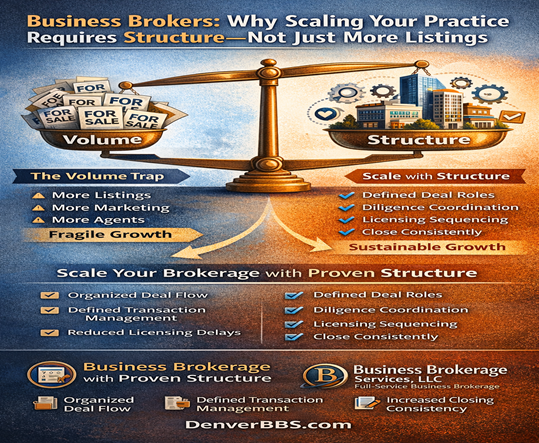
The Volume Trap Many Brokers Fall Into
Many traditional brokerage firms grow by:
Adding more listings
Increasing marketing outreach
Expanding buyer databases
Hiring additional agents
On the surface, this appears to be growth.
In practice, it often creates:
Administrative overload
Broker bottlenecks
Missed diligence deadlines
Lease coordination delays
Licensing sequencing errors
Increased deal fallout
Without structural support, scaling volume increases fragility.

Where Competitor Models Typically Break Down
Across the industry, a recurring pattern appears:
The broker secures the listing.
The broker markets the business.
The broker negotiates the LOI.
The broker manages diligence.
The broker coordinates with lenders.
The broker negotiates with landlords.
The broker oversees closing.
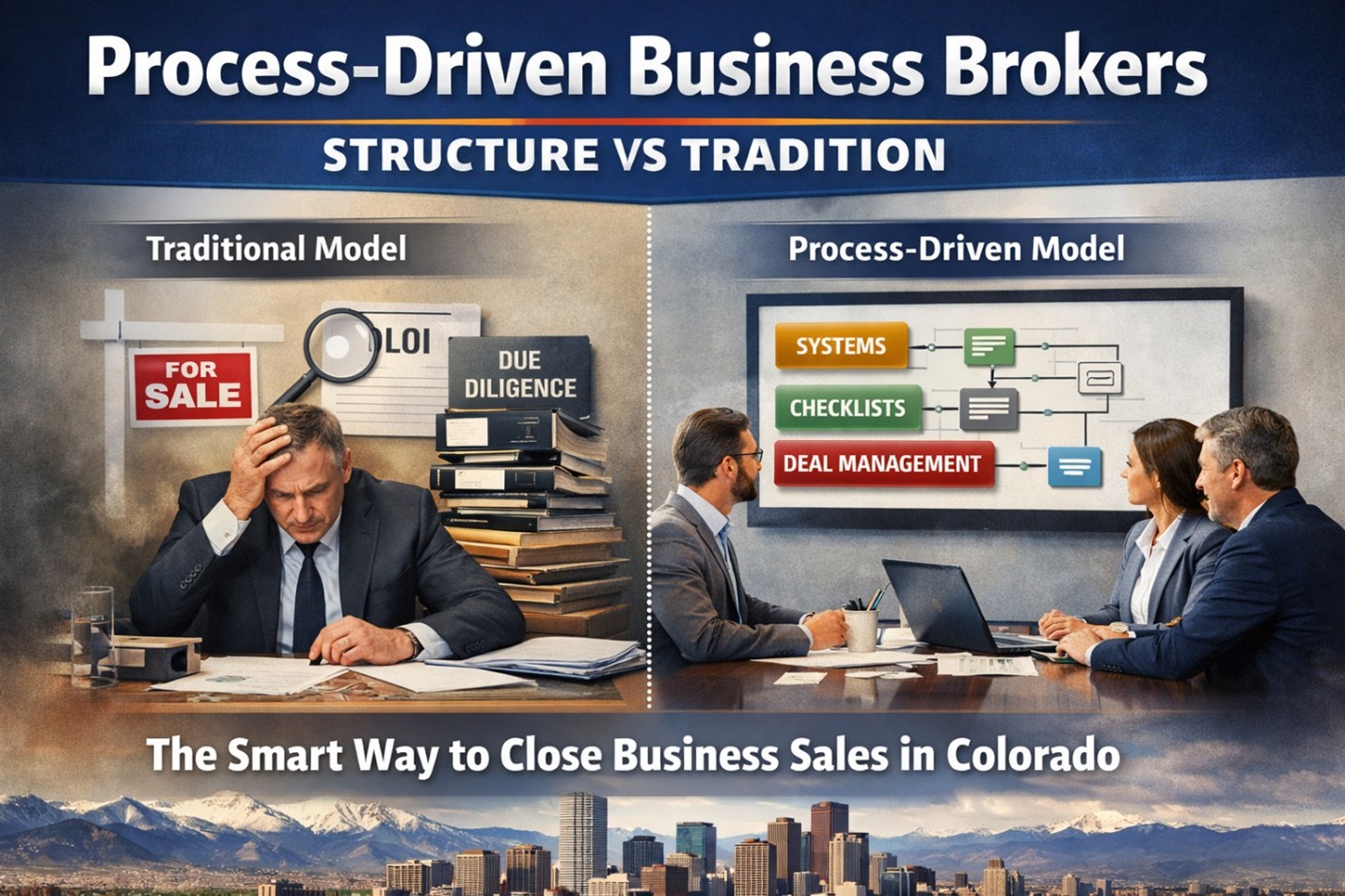
This “all-in-one” model works at low volume.
It breaks at scale.
When every transaction depends on a single broker’s bandwidth, growth hits a ceiling.

The BBS Structural Model
Business Brokerage Services was designed intentionally to address these scaling limitations.
Our model includes:
Director-level oversight of client relations
Dedicated transaction and licensing coordination
Structured milestone tracking
Defined diligence management processes
Organized deal room systems
Clear communication channels between buyers, sellers, lenders, and landlords
This segmentation allows brokers to focus on high-value tasks:
Relationship management
Negotiation
Strategy
Deal positioning
Execution is managed through structure—not improvisation.

Why Licensing & Compliance Structure Matters
Colorado business transactions frequently involve:
Local and municipal licensing requirements
Industry-specific regulatory approvals
Sales tax registrations
Landlord approvals and lease assignments
When these items are handled reactively, deals stall.
When they are sequenced properly within a structured timeline, transactions move predictably.
Competitors often treat licensing as a final-stage item.
BBS integrates compliance planning into the transaction pathway from the beginning.

Technology as an Execution Tool
Many brokerage CRMs are designed primarily for:
Listing storage
Buyer outreach
Contact tracking
At BBS, systems are built to support:
Structured task sequencing
Communication documentation
Milestone tracking
Deal room organization
Role-based accountability
Systems reduce variability.
Reduced variability improves closing consistency.

Why This Matters to Independent Brokers
Independent brokers across Colorado are experiencing increasing complexity:
More sophisticated buyers
Increased lender documentation standards
Greater regulatory oversight
Higher seller expectations
Scaling without infrastructure leads to burnout.
Scaling with structure leads to sustainability.
If your growth strategy depends solely on adding listings, your administrative load will eventually outpace your closing capacity.
If your growth strategy is built around process segmentation and defined transaction management, you gain leverage.

The Competitive Advantage You Can Sell
For business brokers evaluating their own models, the differentiator is no longer marketing reach.
It is execution control.
Sellers are beginning to ask more detailed questions:
Who manages diligence timelines?
Who handles landlord negotiations?
Who ensures licensing compliance?
Who tracks closing milestones?
If your competitors answer vaguely, you can answer specifically.
Specificity builds confidence.
Confidence wins listings.

The Future of Brokerage Growth
The next generation of brokerage firms will not be defined by:
Brand size
Number of listings
Geographic footprint
They will be defined by:
Transaction consistency
Process discipline
Role segmentation
Closing reliability
Business Brokerage Services, LLC operates within this structured model.
Not because it sounds impressive.
Because it works.

Final Thought
If you are a broker asking how to scale your practice, the answer is not:
“Add more listings.”
The answer is:
“Build infrastructure that protects execution.”
Listings create opportunity.
Structure creates growth.

Business Brokerage Services, LLC
Serving business owners and brokers across Colorado
https://denverbbs.com

Leave a Reply

Your email address will not be published. Required fields are marked *